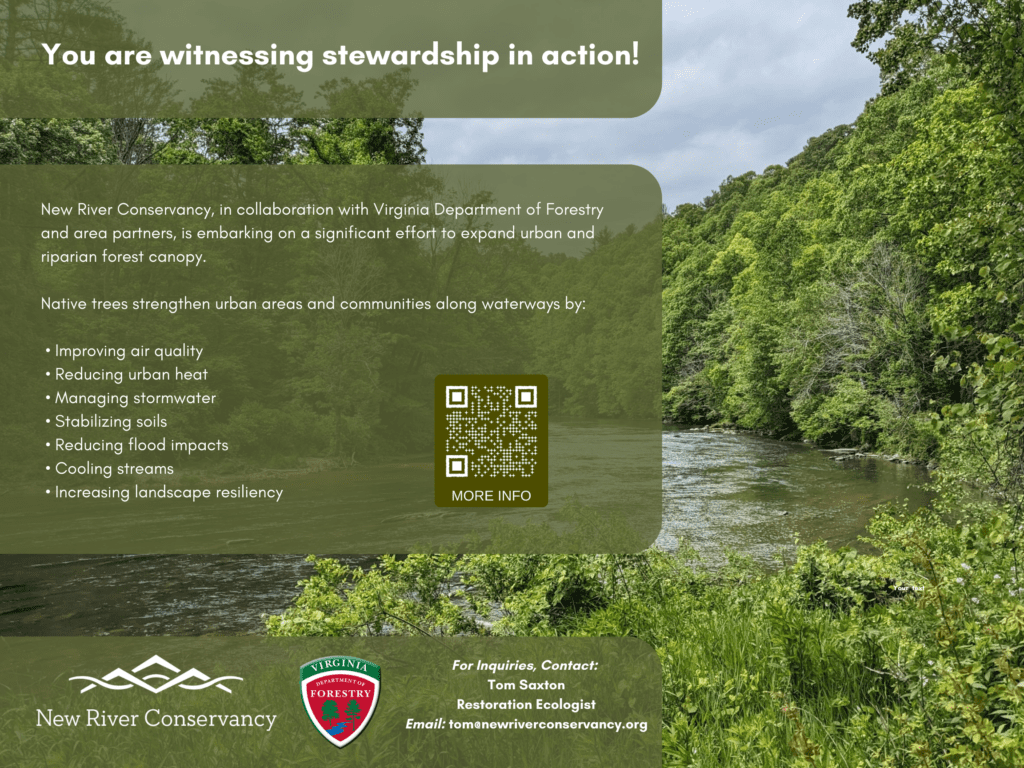

New River Conservancy, in collaboration with Virginia Department of Forestry and area partners, is embarking on a significant effort to expand urban and riparian forest canopy. Over 15,000 trees will be planted across all the projects.
Restoration is one of our most challenging yet satisfying missions. Addressing eroded riverbanks and ridding the New River of threats to water quality is meaningful, hands-on work — the kind of work that makes a tremendous difference for the river we all love. But we can’t do it without help from others who share our appreciation for the New River. Whether we’re building up a critical buffer or clearing the river and its watershed of litter and debris, we and our partners work every day to help protect this treasured place.
What is a riparian buffer?
A riparian forest buffer is an area adjacent to a stream, lake, or wetland that contains a combination of trees, shrubs, and/or other perennial plants and is managed differently from the surrounding landscape, primarily to provide conservation benefits. Riparian buffers can also be managed to include trees and shrubs that produce a harvestable crop along with the conservation benefits, although this is less common. Buffers are used in agricultural, row crop, range, suburban, and urban settings. A wide variety of state and federal programs support the installation of riparian forest buffers on public and private lands.
Riparian forest buffers can deliver a number benefits including filtering nutrients, pesticides, and animal waste from agricultural land runoff; stabilizing eroding banks; filtering sediment from runoff; providing shade, shelter, and food for fish and other aquatic organisms; providing wildlife habitat and corridors for terrestrial organisms; protecting cropland and downstream communities from flood damage; producing income from farmland that is frequently flooded or has poor yields; providing space for recreation; and diversifying landowner income.
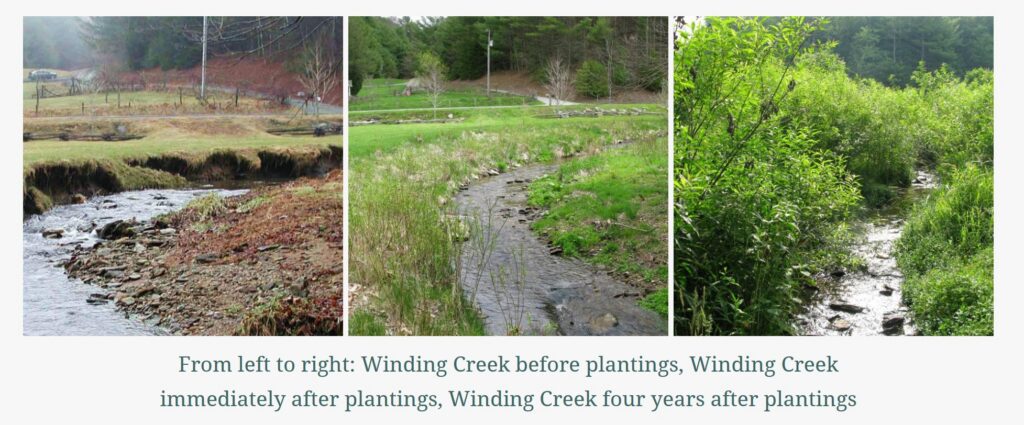
Riparian forest buffers can be included in landscape-scale green infrastructure plans to serve a variety of functions, particularly along the rural-urban interface. Green infrastructure is an approach to conservation that involves creating a network of green areas to benefit people and wildlife. (Forest Service, US Department of Agriculture)
Native trees strengthen urban areas and riparian buffers by:
• Improving air quality by absorbing carbon dioxide and filtering pollutants
• Reducing urban heat through shade and lowering energy costs
• Managing stormwater by intercepting rainfall and increasing soil infiltration
• Stabilizing soils and preventing erosion with deep root systems
• Protecting water quality by filtering sediment, nitrogen, and phosphorus before they reach streams
• Reducing flood impacts by slowing and absorbing storm flows
• Cooling streams and improving aquatic habitat
• Providing essential food and shelter for birds, pollinators, and other wildlife
• Supporting resilient, low-maintenance landscapes adapted to local climate and soils
Thank you
We could not do the work we do in the New River watershed without the help of our local, state and federal partners, as well as our incredible volunteers. We offer our thanks to them all.
Our partners include:
- Draper, VA: Pulaski County
- Hillsville: Carroll County
- Pulaski: Town of Pulaski, Friends of Peak Creak
- Heritage Park (Blacksburg): Town of Blacksburg, Virginia Environmental Endowment
- Radford: Town of Radford, Radford Parks and Recreation, Nursery Natives
- Hiwassee: Pulaski County
- Narrows: Town of Narrows
- Clifton Forge: Town of Clifton Forge
- Damascus: Town of Damascus, FEMA
- Roanoke: Town of Roanoke
- Norton: Town of Norton
Stroubles Creek watershed:
- Ecological Restoration Collaborative
- Watershed Restore
- Virginia Tech Biological Systems Engineering
- Virginia Department of Environmental Quality,
- Virginia Department of Conservation and Recreation
- Virginia Tech Office of Sustainability
- Virginia Tech’s Ecological Restoration Field Practicum course
- Virginia Tech Site and Infrastructure Development
- Virginia Tech Student Budget Board
- Environmental Coalition at Virginia Tech
- Virginia Tech Foundation
- Smithfield Plantation (Stroubles Creek): Smithfield-Preston Foundation
Signage along the newly planted riparian buffers will inform communities about the work and how riparian buffers improve the watershed.