By: John R. Copeland, Water Quality Manager, New River Conservancy
Freshwater mussels (order Unionidae) are bivalves like their saltwater counterparts oysters and clams. Even though they spend most of their lives a short distance from where they emerged from their host fish, these hard-shelled creatures play a critical role in healthy aquatic ecosystems. Why should we care about mussels? How are fish and freshwater mussels inextricably linked? What is the status of freshwater mussels? How are the mussel populations doing in the New River? What unique actions are protecting Claytor Lake mussel populations? Read on to learn more.
Why should we care about freshwater mussels?
Historically, freshwater mussels were used by Native Americans for food, constructing tools, and making decorative jewelry. Before the development of plastics, buttons were typically made from mussels. 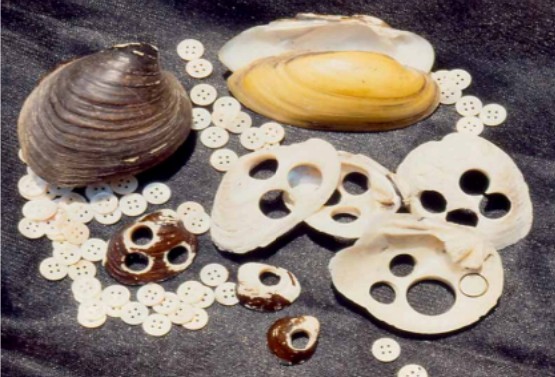 Freshwater mussels are still used in the modern pearl industry. Mussel shells sold to Asian markets are used to make round beads implanted in oysters for pearl production. During the historical heyday of mussel harvest, the total value of the mussel fishery in the United States was estimated at about $10 billion in 2017 dollars.
Mussels serve many functions in the aquatic environment. They are filter feeders, taking in water and dissolved materials through their siphons, filtering out bacteria, algae, and small particles, resulting in improved water quality. They are a food source for multiple animals, including fish, reptiles, birds, and mammals. Mink, otters, raccoons, and muskrats all munch on the soft fleshy interior of freshwater mussels. Mussel shells provide surfaces where aquatic insects, algae, and even rooted aquatic plants find a home. Even when dead, mussel shells serve as habitat for small bottom dwelling fishes, like madtoms and darters. Freshwater mussels are often long-lived, surviving from 20 to 100 years. As a result, they serve as important biological indicators of pollution, like canaries in the coal mine, letting us know something is wrong if their numbers decline.
The freshwater mussel life cycle is complex and interesting. Because they live a sedentary life, mussels depend on water currents to reproduce. Male mussels release sperm, which fertilizes downstream female mussels who draw the sperm in through their incurrent siphon. A single female holds hundreds to thousands of fertilized eggs, which develop into glochidia in her gills. Once these glochidia mature, they are released into the flow, where they attach to fish gills, fins or scales to develop. Female mussels often use unique attraction techniques like mantle tissue extending from their shells that look like small fish as a means to shoot their glochidia onto suitable host fish. Fish host species are often specific to the particular mussel species, so, if the glochidia find a suitable host fish, they become encysted until they mature and drop off as juvenile mussels. Because the glochidia attach to fish, which readily move, juvenile mussels inhabit new areas they otherwise would not have reached. If these juvenile mussels survive, they develop into adults and continue their life cycle.
What is the status of freshwater mussels?
When European settlers first arrived on the North American continent, they were amazed to find that many rivers were almost paved with freshwater mussels. North America is still a global hot spot for freshwater mussel diversity with over 300 species known historically (about 1⁄3 of the world’s freshwater mussel species). The Southern Appalachian region has one the most diverse concentrations of mussel populations in North America, with the most diverse populations found in the southeastern drainages of the Ohio, Tennessee, Cumberland, and Mobile rivers. The Tennessee river drainage is home to nearly 102 species alone.
Unfortunately, mussels are among the most imperiled animal groups in the world. The fact that these fascinating species cannot move long distances means they are exposed to stressors that cause population declines, including habitat loss, flows altered by dams, environmental contaminants, host fish migration barriers, and introduction of non-native species. Best estimates are that 70% of the freshwater mussel species in North America are imperiled. Over 7% have gone extinct and another 50% are protected under the Endangered Species Act. In Virginia alone, of the 82 species known, only 30% are considered stable, with the remaining species in decline.
What is the status of freshwater mussels in the New River?
Although the New River’s mussel species diversity is low compared to nearby river drainages like the Tennessee, it still is home to 12 species of freshwater mussels, including a few that are imperiled. Unfortunately, the best information available for New River mussel populations indicates that declines in species and abundance of mussels have occurred. The environmental stressors mentioned earlier that impact mussel populations have resulted in New River mussel declines over time.

Figure 6: Pistolgrip mussel (Tritogonia verucossa)
One unique fact about New River mussels is that the species known as Pistolgrip, although widespread throughout its range, is only known in the Virginia portion of the New River. Fortunately, there are no known mussel species extinctions or extirpations in this river drainage, with the exception of the Pistolgrip believed to be extirpated in the North Carolina portion of the New River based on biologist’s surveys. No New River basin mussel species are federally endangered, but there are 3 imperiled species in Virginia, including the Tennessee heelsplitter listed as state endangered and the Green floater and the Pistolgrip listed as state threatened. The Green floater is currently undergoing evaluation by the U.S. Fish and Wildlife Service to be listed as a threatened species under the Endangered Species Act (Available Species Profile for Green floater (Lasmigona subviridis) Accessed 6/25/25). While the New River basin’s freshwater mussel fauna is known as lacking in numbers and variety of species, particularly with respect to nearby river basins, and therefore has not received as much attention from mussel biologists, current mussel distribution information is available (Table 1).
The Virginia Department of Wildlife Resources (VDWR) recently (2022-2023) began stocking mussels in a portion of the New River below Claytor Lake near the community of Parrott. Species released include Pistolgrip, Purple Wartyback, Pocketbook, and Spike. Follow up surveys indicate good growth and survival, even though intense flooding was experienced post-release. Collaboration between VDWR and Virginia Tech will continue these efforts in more areas to spread out risk and improve populations in the New River watershed in the future.
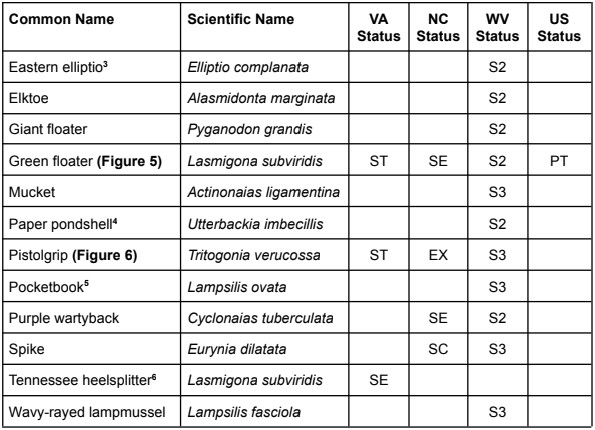
Table 1: Common and scientific names of freshwater mussel species occurring in the New River basin where SE = state endangered, ST = state threatened, PT= Proposed threatened by U.S. Fish and Wildlife Service, SC = special concern, EX = Extirpated, S2 = Imperiled, S3 = Vulnerable. Common Name Scientific Name VA Status NC Status WV Status US Status

Figure 5: Green floater mussel (Lasmigona subviridis)
Claytor Lake Mussels – Rescuing Mussels through Community Action
A prominent feature of the New River in Virginia is the 21-mile long mainstem hydroelectric impoundment Claytor Lake. During the Federal Energy Regulatory Commission relicensing proceedings for this Appalachian Power Company dam in December 2011, landowners represented by the Friends of Claytor Lake requested continued fall drawdowns for
shoreline maintenance projects. Relicensing studies on freshwater mussel mortality during fall drawdowns (previously done annually with a 5 foot drawdown and an occasional 8 foot drawdown) demonstrated that mussel mortality was highest in the zone beyond 5 feet due to bird and mammal predation, desiccation, and freezing, so limiting the extent of the drawdown and the time of year could result in reduced mortality. After negotiations with the Virginia
Department of Wildlife Resources, Appalachian Power Company, Friends of Claytor Lake, and other interested parties, a compromise was reached to allow fall drawdowns of 5 feet every 2 years in early November for 9 days in order to limit freshwater mussel mortality.
Some of the same mussel species known from the New River basin in Virginia are broadly distributed in Claytor Lake, with the mussel fauna dominated by species that prefer reservoir environments like the Giant floater and Paper pondshell. Two species of special status are also known in Claytor Lake including the Green floater and Pistolgrip, both state threatened species. Through the collaboration of the Friends of Claytor Lake, Virginia Department of Wildlife Resources, Claytor Lake State Park, Appalachian Power Company, and other interested community partners, during the biennial Claytor Lake drawdowns, hundreds of volunteers come out for a mussel salvage day held on the first day the lake is fully drawn down. This unique effort has resulted in the rescue of thousands of Claytor Lake mussels,
including the 2 state threatened species, as volunteers return them to the water during systematic searches along shoreline areas with known high mussel populations. This years’ drawdown occurs on Saturday, November 8, from 9:30 – 1:00 PM. For more information, please visit HERE
.