
West Jefferson, NC – Working with a broad regional partnership including the Appalachian Citizens Law Center, Appalachian Voices, the Ohio River Valley Institute, and the National Parks Conservation Association, the New River Conservancy has published findings from a year-long study of the resiliency system emerging from Hurricane Helene’s response.
Funded with a grant from the Volgenau Climate Initiative, the study focused on providing recommendations for regional resilience-focused networks, systems and coalitions by analyzing the response to 2024’s devastating Hurricane Helene. Brendan Muckian-Bates of the Appalachian Citizens’ Law Center, a non-profit law firm based in Kentucky’s coal country and project partner spoke about the importance of sharing the resilience experience across the Appalachian region: “The resilience shown by one part of the greater Appalachian region can offer critical learning as other parts our landscape build resilience partnerships and prepare for future natural disasters.”
Among the findings, the study recommends that existing networks be strengthened to include resilience-focused work rather than the development of new organizations or coalitions, primarily due to the capacity restraints involved in long-term recovery. Also highlighted were ways that regional partnerships can be strengthened to better prepare for future disasters and regional challenges. Existing partnerships that cross state-lines, that support local implementation of recovery work, and that help communities navigate complex and confusing recovery systems were all highlighted as areas of necessary growth across Appalachia’s resiliency systems. Emma Kelly, New Economy Program Manager for Appalachian Voices spoke to the long-term value of this study: “We greatly appreciate the chance to be a part of this initiative which provides a deeply needed regional view of Appalachian resilience and disaster response. As our networks continue to adapt around increasing climate disasters, this report gives us a roadmap for stronger and more effective collaboration.”
Olivia Porter, Southern Appalachian Landscape Project Director for National Parks Conservation Association, adds: “Across Southern and Central Appalachia, communities share deep connections to wild places and to each other. This study is proof that Appalachian communities can and should work together to protect the places we love from threats like flooding, intense storms, and more. Our communities have worked hand in hand towards recovery and resilience in the wake of Hurricane Helene. This study suggests we should go further, work closer, and collaborate on resilience efforts through the entire region. Together, we can create an Appalachia that is resilient, strong, and vibrant for future generations.”
Completed by Oxbow Strategies, a management consultancy based in Roanoke, Virginia, the study collected information from regional and national resilience-focused conferences, engaged local leaders directly, and developed feedback from a wide range of partners and resilience practitioners. Michael Clark, Principal Consultant on the project summarized his perspective on the study: “What became clear through this work is that Appalachia doesn’t lack for people or organizations committed to resilience. There is an incredible amount of good work already happening across the region. The opportunity, rather, is to connect those efforts more intentionally, make it easier for communities to find and learn from one another, and build the relationships now that we’ll inevitably need when the next disaster comes.”
The New River Symposium 2026, held at Appalachian State University in Boone, North Carolina where Hurricane Helene severely impacted the New River watershed, was expanded to include information-recovery systems for this study. New River Conservancy Executive Director, Andrew Downs was a partner on the project: “Helping share the story of the New River’s resilience after Helene, in a way that communities across Appalachia will create lasting value from this study and the 2026 New River Symposium. The better we can share what we’ve learned from Helene, the stronger Appalachia will be in the future.”
The study can be found and downloaded here: https://newriverconservancy.org/resiliency-report/
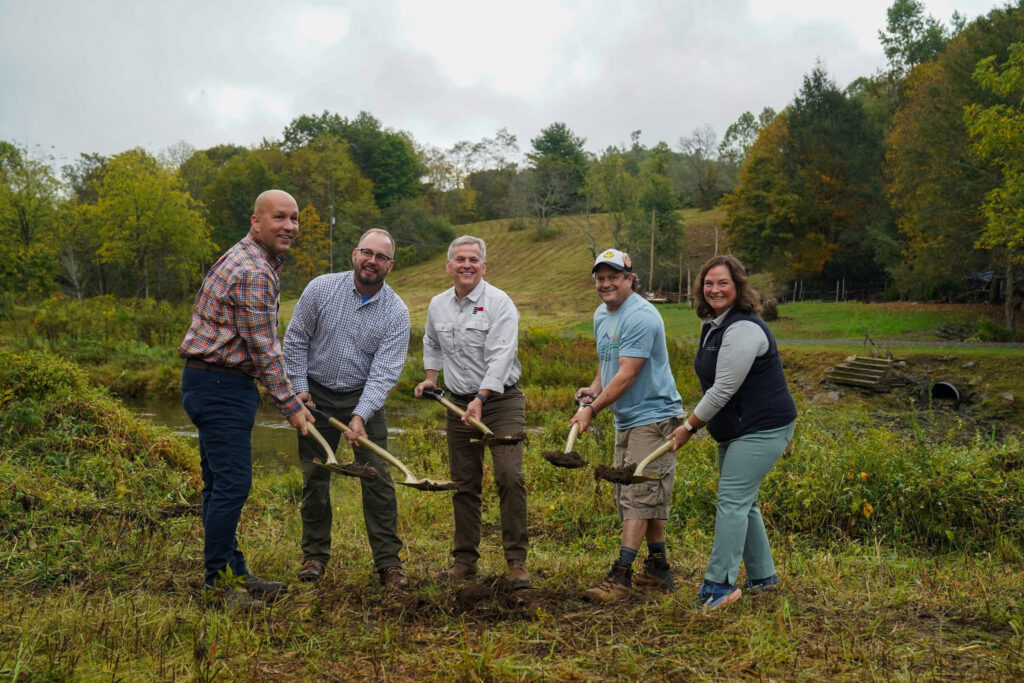
Resiliency, recovery and partnerships go hand-in-hand. (L-R) Todd McNeill, Chair of the Ashe County Commission; Andrew Downs, Executive Director of New River Conservancy; NC Governor, Josh Stein; James Littlejohn, then- President Greater Lansing Area Development; and Guenevere Abernathy, NC State Director for The Conservation Fund break ground for the first access location on the North Fork of the New at the Deep Ford property in Lansing, NC one year after Hurricane Helene devastated this community. September 2025.