New River Conservancy and Open Spaces Resiliency Project Partner to Restore South Beaver Creek
Multi-year collaboration will improve water quality, restore wetland habitat, and engage local volunteers.
New River Conservancy (NRC) and the Open Spaces Resiliency Project (OSRP) have partnered to restore a stretch of South Beaver Creek on privately owned property, marking a new phase of collaborative conservation work on Beaver Creek, a direct tributary to the South Fork of the New River entering just upstream of New River Access Park on Route 163, which NRC and partners built just two years ago.
The two-year partnership aims to restore wetlands and stream habitat along South Beaver Creek. The project aims to improve downstream water quality, reduce sediment transport, enhance biodiversity, and create opportunities for community members to take part in hands-on conservation work.
Erosion of South Beaver Creek into the area floodplain is contributing sediment pollution into Beaver Creek, and ultimately the New River. Sediment is the largest threat to water quality. One of the ways to return this wetland in South Beaver Creek back to a healthy state is the use of beavers and beaver dam analogs.
Increasingly, restoration conservationists are using beavers and beaver dam analogs (BDAs) for stream, wetland, and floodplain restoration. Both natural beaver dams and BDAs utilize natural materials to impound water and retain sediment in shallow pools. Such wetland areas provide benefits to plants, fish, and wildlife while improving downstream water quality and flood resilience.
Steve Bevington, Conservation Program Manager at NRC, explains: “Floodplains are an essential and rich feature of the New River Watershed. BDAs are an inexpensive and effective method to both restore natural resources of South Fork New tributaries and enhance the ability of existing floodplains to mitigate and limit the impacts of future floods.”
BDAs are hand-built, temporary stream-restoration structures that mimic natural beaver dams. Made from wooden posts driven into a streambed with woven branches, mud, and local brush, BDAs slow water flow, raise depleted water tables, trap sediment, and help re-establish damaged wetland and riparian habitats.
Throughout the project NRC will coordinate with local landowners and permitting authorities, develop and implement the restoration plan, and organize community planting and clean-up events with community outreach and volunteer recruitment. OSRP will lead baseline ecological surveys and habitat mapping, and support the permitting process.
“Restoring a working stream system like South Beaver Creek takes strong local partnerships and sustained commitment,” said Jeff Gray, Project Director of the Open Spaces Resiliency Project. “We’re glad to bring our scientific and planning resources to support NRC’s on-the-ground leadership and the local community’s investment in this landscape.”
The project builds on both organizations’ broader missions to protect and restore waterways in the North Carolina High Country. Restoration activities, including volunteer planting days, are expected to begin as project planning and permitting are completed in late spring of 2027.
Andrew Downs, NRC Executive Director, says “Strong partnerships are the backbone of our organization. We are grateful to OSRP for the opportunity to further our mission in Ashe County, NC.”
#####
About New River Conservancy: New River Conservancy is a nonprofit working in North Carolina, Virginia and West Virginia. Since 1976, the NRC has dedicated their mission to protecting the woods, waters, and wildlife of the New River watershed. NRC is a 501C3 non-profit organization and all donations are tax deductible. Learn more at newriverconservancy.org.
About Open Spaces Resiliency Project Open Spaces Resiliency Project is a conservation initiative operating under fiscal sponsorship of the Southern Conservation Partnership, focused on ecological resiliency and habitat restoration across the region. Learn more at ncopenspaces.org.

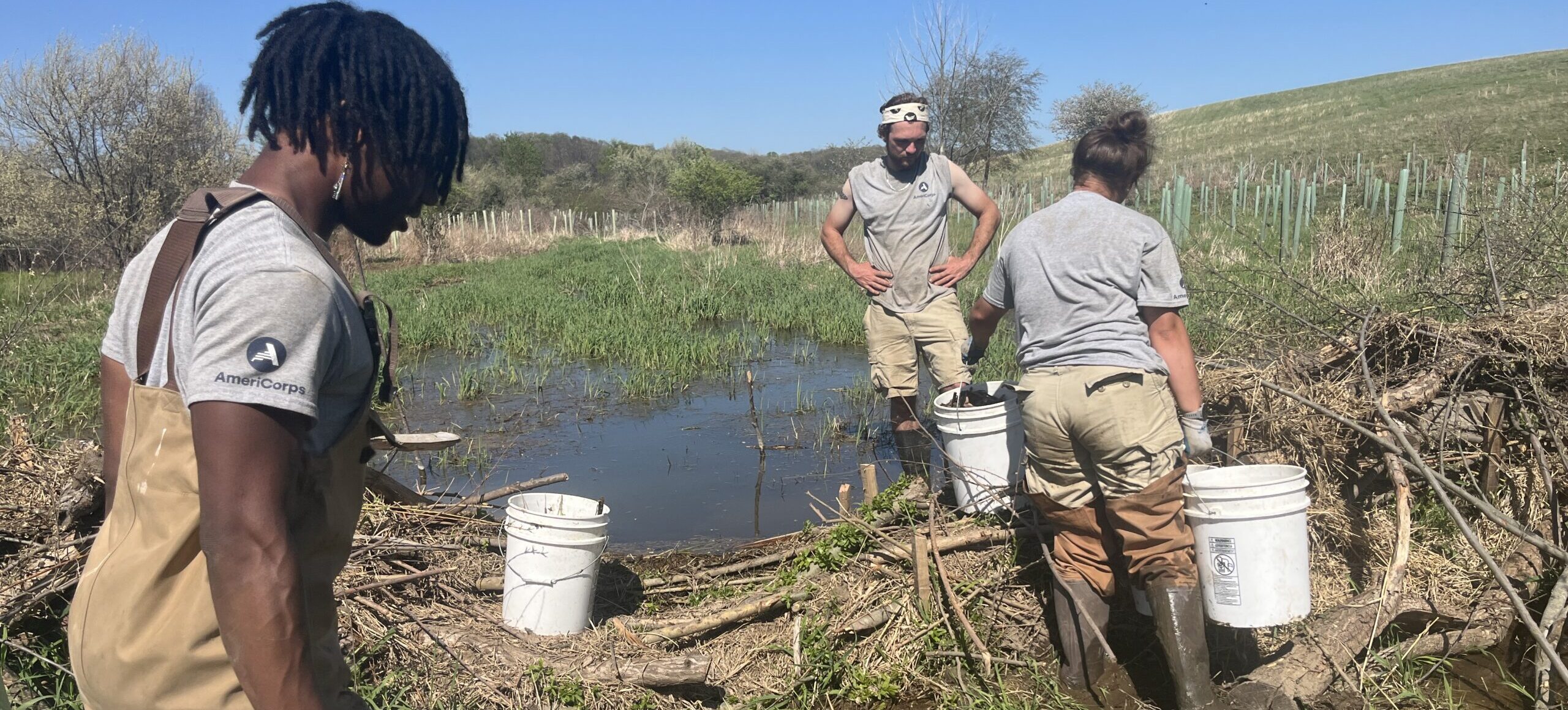
NRC AmeriCorps Grizzly Team work on a BDA in Montgomery County, Virginia. Beaver dam analogues (BDAs) are constructed with material that is similar to what beaver use to build their dams. Depending on what type of BDA is constructed, this may include sediment ranging in size from cobbles, gravel, sand, silt and clay, vegetation such as the stalks of emergent vegetation, and the branches and stems of deciduous trees and shrubs.